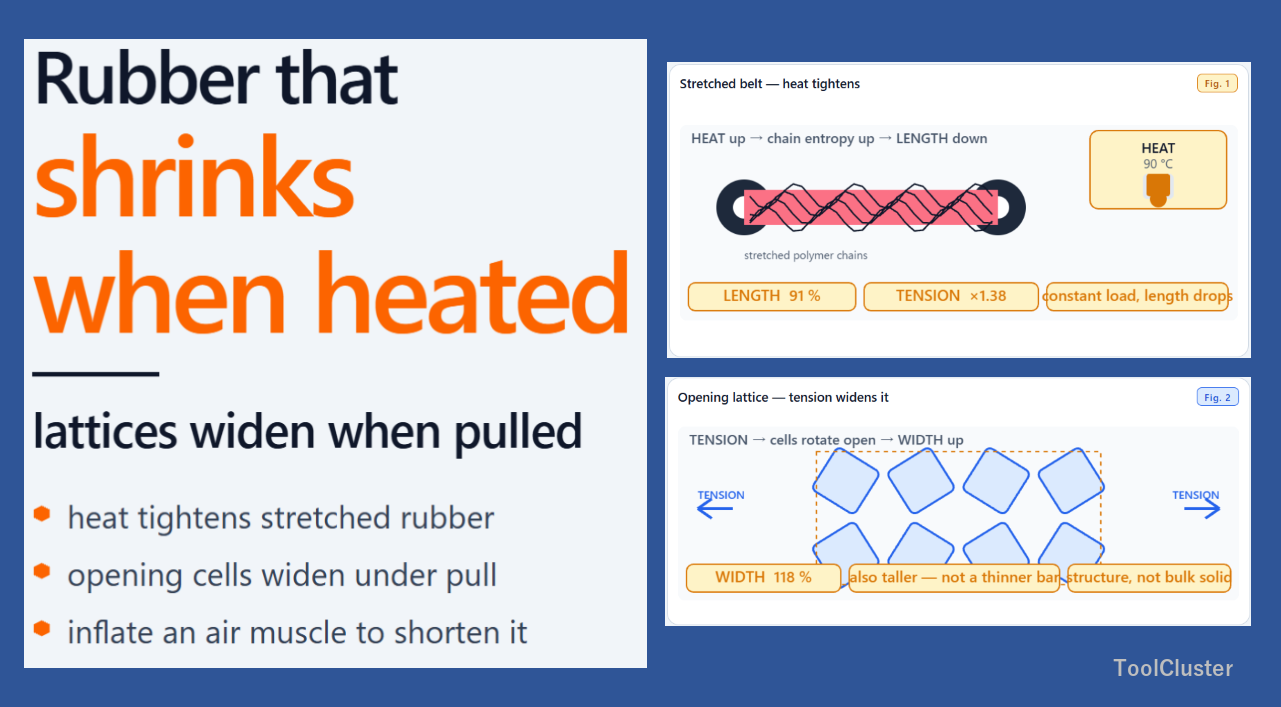
Machine parts do not always behave the way our intuition says they should. A belt under tension, for example, shrinks and tightens further when heated instead of going soft, and a lattice made of a single, uniform material can grow wider in outer profile when pulled. An air-filled tube gets shorter as it swells sideways, and a bolt tightened firmly in advance does more than hold the joint together — it can also divert fluctuating loads into the clamped faces.
Behind each of these broken intuitions is the fact that the configurations a molecule can take, the geometry of a cell, and preload can all be made into design variables. In this article, let’s use live diagrams to understand why the intuition fails.
Key points of this article
| Section | What this section explains |
|---|---|
| Thermal contraction of a stretched belt | Not “heat makes it longer.” Stretched rubber moves toward shrinking as heat rises |
| Sideways widening of an opening lattice | Not “pulling makes it thinner.” As the cells open, the lattice widens sideways too |
| Air muscle contraction | Not “inflating makes it longer.” The braid trades thickness for length |
| Bolt preload and fluctuating load | Not “pre-tightening is wasted.” The clamped faces take the load cycle first |
Thermal contraction of a stretched belt
Shrinking when heated is the work of stretched rubber as a material — its natural motion. On real parts, you see it in timing belts and rubber couplings. So consider rubber that is already under tension, and now gets warm. Intuition says a solid softens with heat and gets longer. In a stretched polymer, though, heat increases the number of configurations each chain can take, and the more configurations open up, the harder the chain pulls back toward its original length. (A chain that has been pulled nearly straight tries to return to the side with more ways to fold, so the distance between its ends shrinks.) Under a constant load the part therefore shrinks, and at a constant length its tension rises. This response is called the Gough–Joule effect.
Here we take the rubber coupling on a servo as our example, and within the servo loop we treat the coupling as a spring. Its spring rate is not the room-temperature catalog value. As heat builds, the stretched rubber moves toward tightening, while the metal pulleys and shafts expand. So if you count on heat to give you slack, you end up with too little tension after cooling and a part that is more likely to snap while hot. There are other materials whose crystals lose volume with heat, but this chapter stays with the work of stretched polymers.
The diagram below shows a belt stretched between two pulleys. As the heat rises, the chains gain more folds, the belt shrinks, and the tension readout climbs.
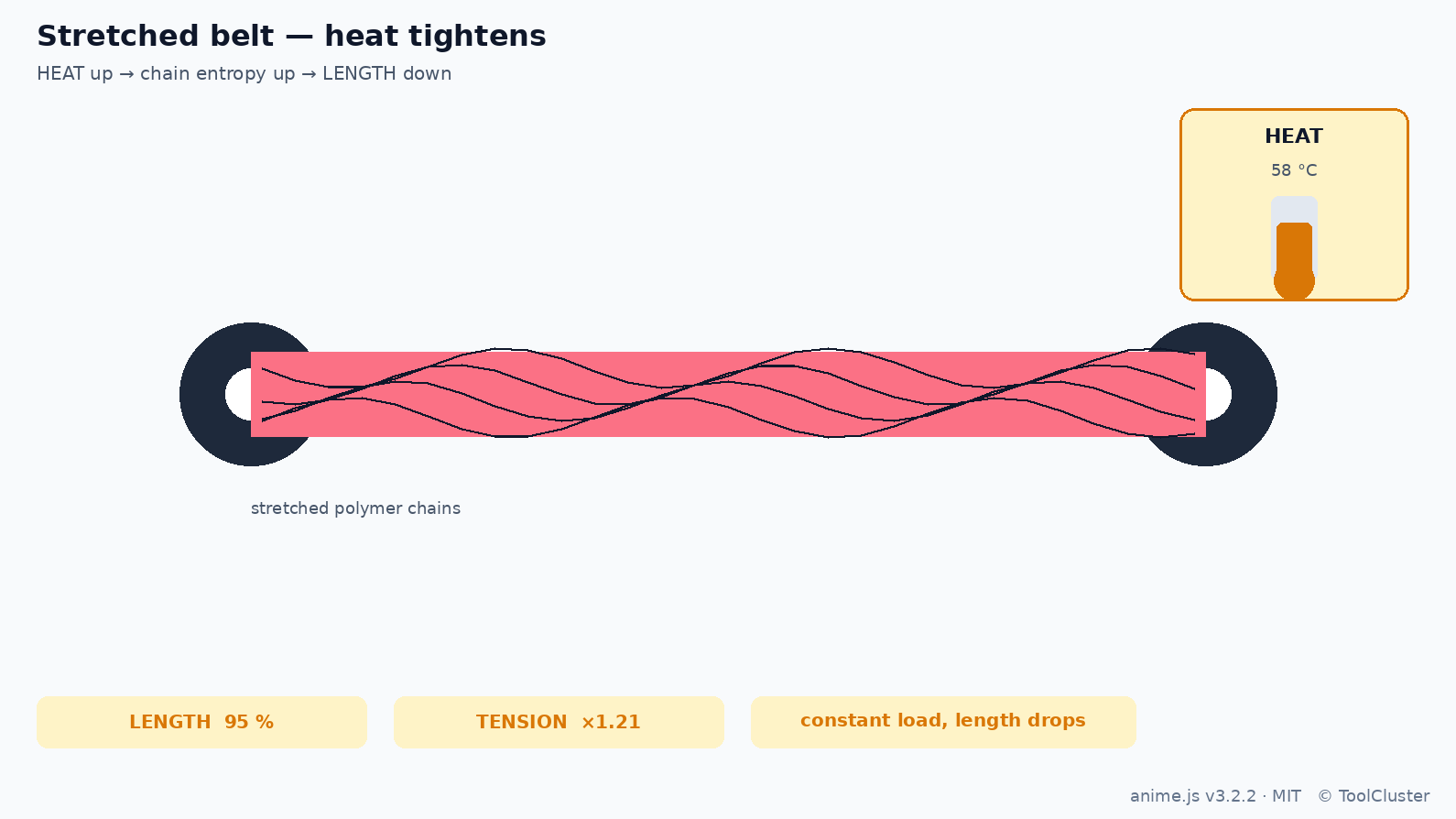
Before adding tension, check the length at operating temperature. A tension that is just right at room temperature can be too much once heat sets in. The coupling’s flex is the same spring as the mechanical side of servo loop lag.
Assuming “it will stretch when warm” and cranking in extra tension at room temperature. Stretched rubber moves toward tightening as it heats. Sometimes the metal side’s expansion cancels that out; sometimes one side simply wins.
Sideways widening of an opening lattice
Pull a bar lengthwise and it gets thinner across — that is the intuition for a homogeneous solid. In a lattice of inward-dented cells, though, tension makes the cells rotate open. The lattice then widens both along the pull and across it. This response is called a negative Poisson’s ratio, and such structures are called auxetic. The material is not a magic bulk solid; the shape of the cells is what redirects the force.
On the floor, this shows up as gripper pads and as inserts that spread an impact over a surface. This is separate from CAD lofting or bending procedures. Place the lattice as a part, and during a grip the pad does not squeeze out sideways — the face moves in toward the workpiece. The way a wrapped wire’s holding force grows exponentially with wrap angle is another example of friction and geometry used as design variables, but here we stay with the work of opening cells.
The diagram below shows a lattice of rotating squares. When tension pulls from both sides, the squares rotate open and the outer frame grows in both width and height.
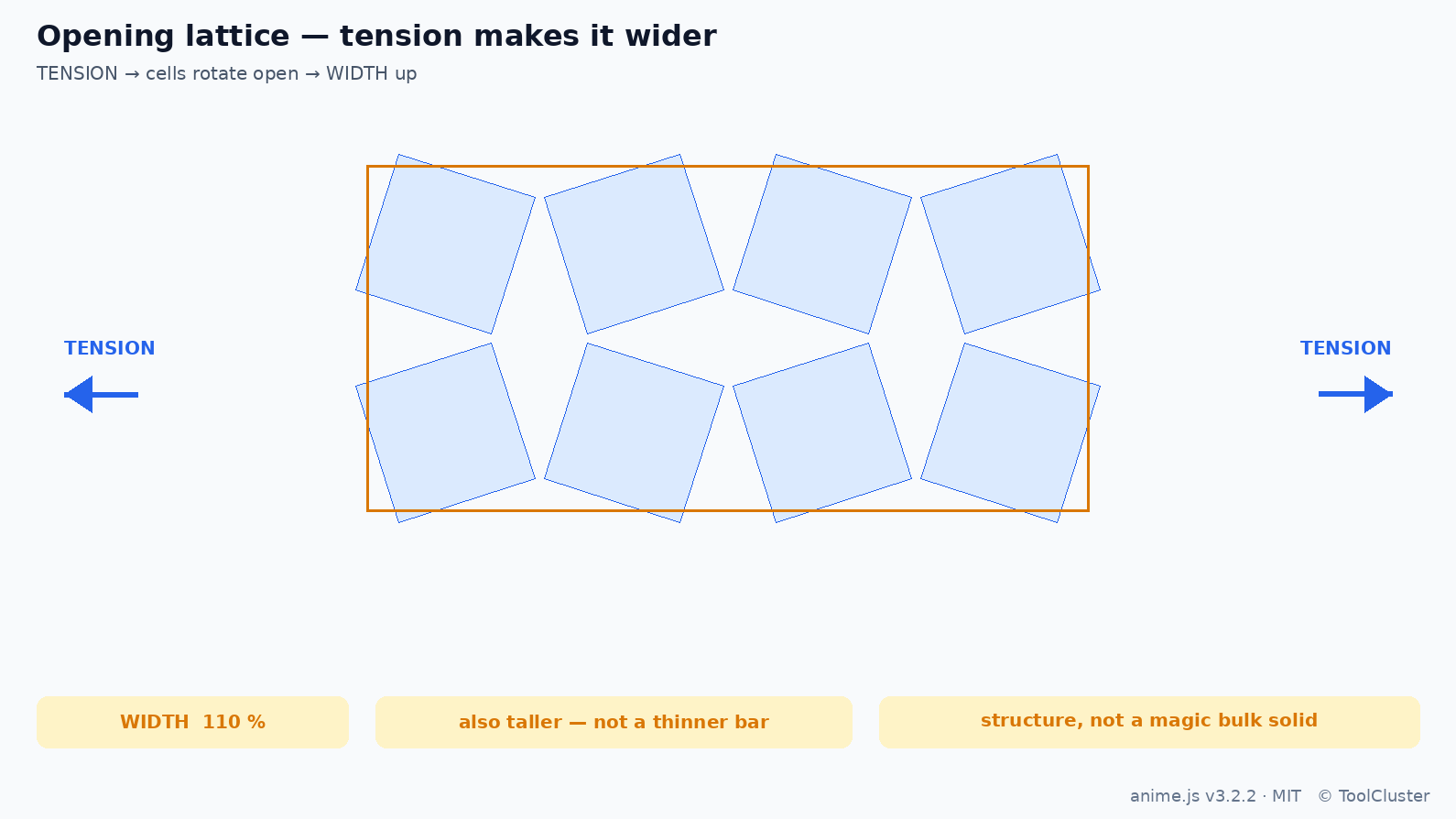
A catalog’s “soft rubber” and a lattice’s widening are different things. The former is close to the Poisson’s ratio of a homogeneous solid; the latter is the geometry of opening cells. When choosing a pad, look at a cross-section photo first.
Assuming the whole foam is a material that gets thicker no matter which way you pull. What matters is the cell shape and the direction of tension. Get the direction wrong and you are back to plain perforated rubber.
Contraction of an air muscle
Put air into a rubber tube and it should get longer, like a balloon — that is the intuition. In an actuator wrapped with a braided sleeve, though, the inner tube getting thicker changes the braid angle. The overall length then shortens, pulling the two ends together. In other words, it is a machine that contracts by inflating. This design is called a McKibben artificial muscle — on the floor, an air muscle.
Most robot joints are rotary. The diagrams in inverse kinematics also solve for link angles. An air muscle, by contrast, is an actuator that changes length. Valve open and close can be driven from PLC outputs. That said, this is not about a cell PLC dictating the trajectory every cycle: a length command and an arm-angle command play different roles.
The diagram below shows internal pressure rising: the diameter grows, the braid changes angle, and the two ends draw together.
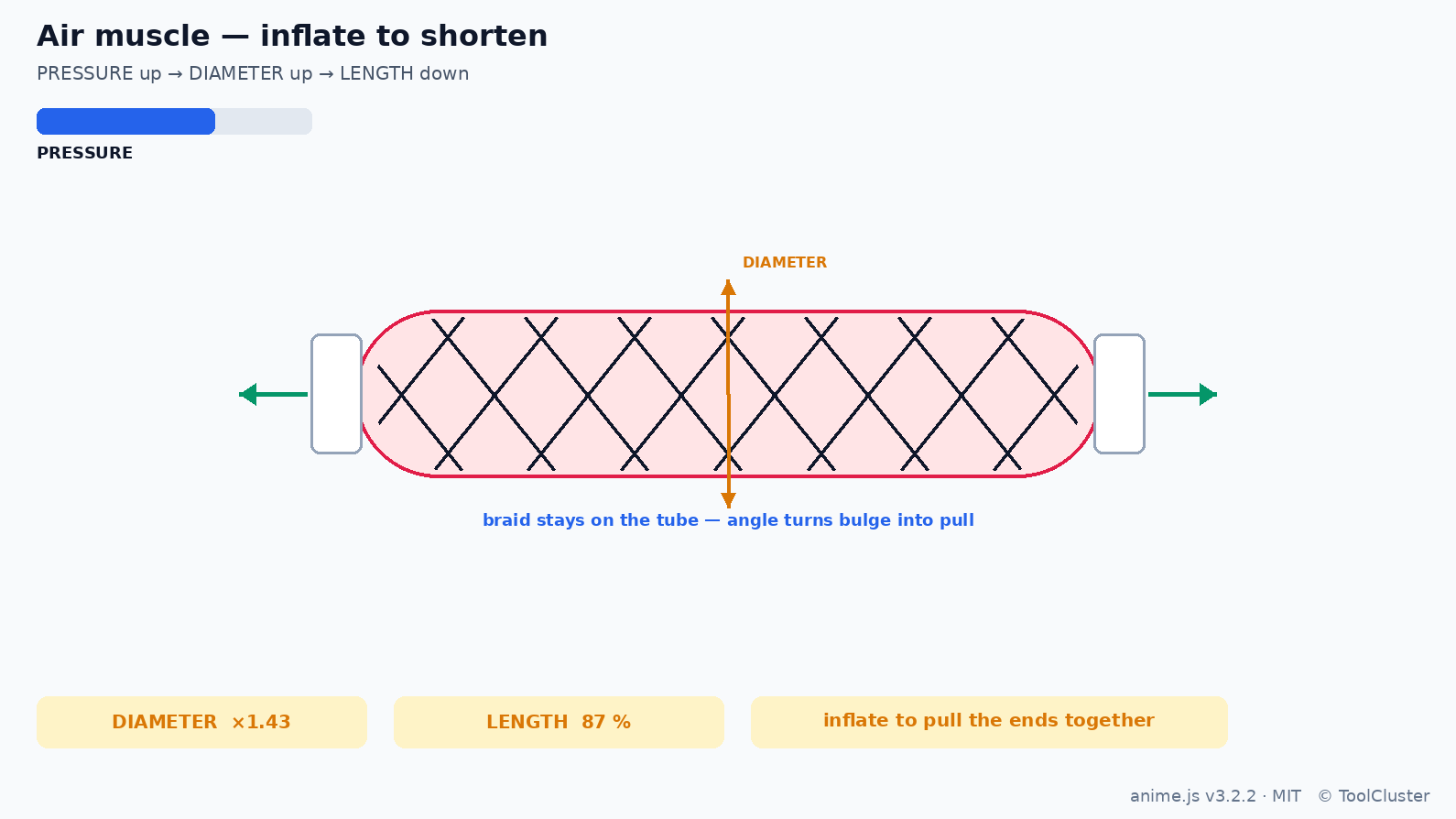
Stroke tops out at the braid angle. Past a certain thickness, adding pressure barely shortens the muscle. It suits jobs that need force over a short pull, like gripping and clamping; long straight positioning belongs to the ball screw.
Thinking you can drop one in place of a motor and get the same trajectory. An air muscle is closer to a spring that changes length. Closing the position loop with an encoder is work that remains.
Bolt preload and fluctuating load
A bolt that will soon carry external load — pulling it hard in advance seems like waste. That is the intuition. But a tightened bolt’s shank stretches slightly, and the clamped faces compress slightly. A bolted joint, in other words, is those two springs deflected ahead of time. In a joint with proper preload, most of an external tensile load goes into relieving the compression of the clamped faces. The swing in the bolt’s tensile stress can be made smaller than it would be without preload — and fatigue cares about this swing, not the average. The screws that hold down a positioning table are this same shank spring; the loop lag is covered in the servo article.
With axial force in place first, the contact between the faces takes the load cycle before the bolt does. Shot peening — hammering a surface with countless impacts to leave residual compression — is the same kind of work: put compression in first to lower the tensile amplitude. Autofrettage, where a high-pressure cylinder is yielded once to leave compression on its inner wall, is a separate story built on the same idea, so we do not follow it here.
The diagram below shows external load arriving after preload. The compression of the clamped faces drops first, and the bolt’s tension barely rises. The arrows and the shank stretch are exaggerated so the force directions stay visible; a real joint is already tight, and this is not about parts with play in them.
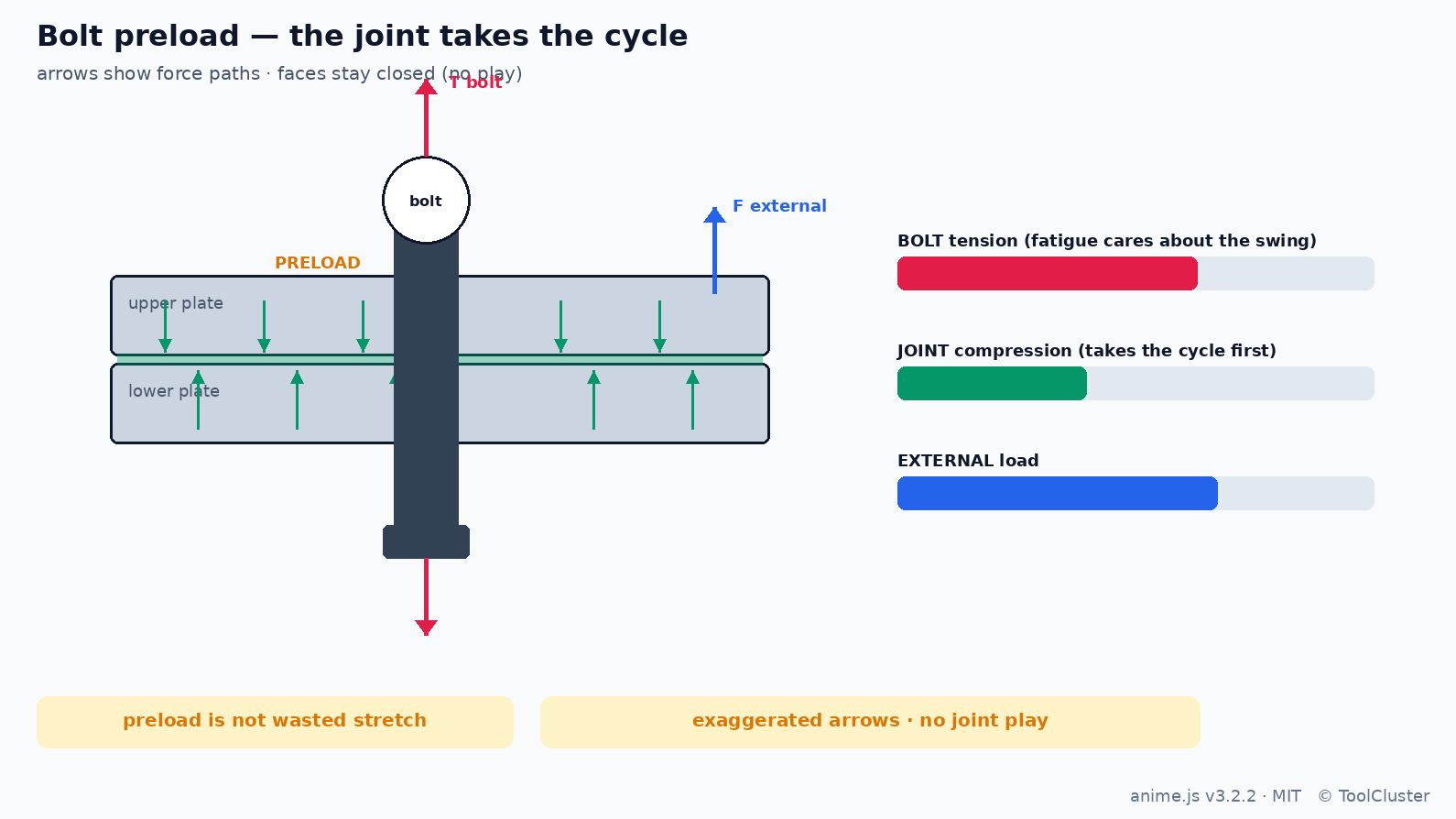
Preload is not “turn it until just before it breaks.” It sits between the point where the faces would separate and the point where the bolt would yield. The moment the faces open, the bolt takes the entire fluctuation.
Reading the number on the torque wrench and calling the axial force good. When friction scatters, the same torque gives a different axial force. On critical flanges, measure axial force by elongation or ultrasonics.
Summary
The intuition of a homogeneous free body fails on real machine parts. A stretched belt shrinks with heat, an opening lattice widens under tension, an air muscle contracts by inflating, and a preloaded bolt diverts fluctuation into the clamped faces. What they share is treating molecular configurations, cell geometry, and preload as design variables. The coupling’s spring leads on to the servo loop; the length-changing end leads on to inverse kinematics.
Frequently asked questions
Q1. Does rubber on a desk also shrink when heated?
A. Only when it is under tension. An unloaded block shows its thermal-expansion side. It is in parts already used stretched — belts, couplings — that heat raises the tension.
Q2. Is an opening lattice the name of a material?
A. It is the name of a structure. If the cells are shaped to rotate open, resin and metal respond in the same direction. It is not a homogeneous bulk where any material simply gets thicker.
Q3. Can an air muscle replace a servo motor?
A. No, it cannot. It is an actuator that changes length, suited to jobs that need force over a short pull. The angle trajectory and the position loop stay with the motor and the encoder.
Q4. Is a bolt better the harder you tighten it?
A. No. Preload sits between what keeps the faces from separating and what keeps the bolt from yielding. Overtighten and you start out in the plastic range, with no margin left for fluctuation.
Q5. Is shot peening the same story?
A. It is a different job built on the same idea. It leaves compression in the surface and lowers the tensile amplitude in service. Bolt preload is axial force in a joint; peening is residual stress in a surface.
Leave a Reply